Investing in AI: which vehicles and what portion of your portfolio?


Artificial intelligence is the most sought-after investment theme right now, and one of the most misunderstood. Buying Nvidia stock, a robotics ETF, or a thematic fund does not mean investing in the same thing: each positions you on a different link in the value chain, with vastly different risk and liquidity profiles. Furthermore, a significant portion of the companies building AI are private and therefore inaccessible via an ETF. Here are the vehicles, the allocation to consider based on your profile, the best account types to use, and the risks to anticipate. And if your goal is to fund AI where it is being built—in the private market—that is precisely what Fundora enables.
Why AI has become a major investment theme
The flow of capital into AI is unprecedented in recent history. Global private investment in artificial intelligence reached $344.7 billion in 2025, more than double the previous year (+127.5%), and total corporate investment in the sector exceeded $581 billion (Stanford HAI, AI Index 2026). The distribution is highly uneven: $285.9 billion for the United States compared to $12.4 billion for China, with Europe accounting for approximately 5% of global funding.
France has shifted gears. During the AI Action Summit in February 2025, €109 billion in private investment was announced for the country, primarily for data centers (Élysée, February 2025). The ecosystem is keeping pace: 1,114 AI startups were identified as of early 2026 (France Digitale), and Mistral AI, France's first decacorn, is valued at €11.7 billion. In the United States, OpenAI occupies a similar position, with a significantly higher valuation.
Sources: Stanford HAI, "AI Index Report 2026", https://hai.stanford.edu ; Élysée, AI Action Summit, https://www.elysee.fr ; France Digitale, https://www.francedigitale.org.
Keep one thing in mind: the speed at which money flows into a sector says nothing about the future performance of the assets; it simply means that valuations have already priced in high expectations.
What are you really investing in when you invest in AI?
"Investing in AI" does not refer to a single asset but to a three-tier value chain with vastly different profitability profiles. Knowing which one you are positioning yourself in is the first decision to make.
NOS OPPORTUNITÉS DE DEAL BY DEAL
5 PORTES D'ENTRÉE SUR LE NON COTÉ
.svg)

%201.svg)

Semiconductors and equipment.
Graphics processors, accelerators, and foundries. This is the layer where value materializes most quickly, but it is also where valuations are most stretched and cyclical dependency is strongest.

Infrastructure and energy.
Data centers, networks, cooling, and power generation. This is a capital-intensive layer with long-term contractual revenues. This is where the bulk of the €109 billion announced in France is concentrated.
Models and software.
Language model developers, development platforms, and cloud services. This is the most competitive layer, where expenses accumulate faster than revenues and where the main global players are not publicly traded.


Business use cases.
Healthcare, industry, logistics, finance, robotics. This is the stage of real monetization—the slowest to emerge and the least effectively captured by thematic indices.
Good to know
How to invest in AI? Five potential avenues
Direct stocks
You buy shares of listed companies involved in one of the four layers. The advantage is total control over your exposure. The constraint is twofold: almost all of these companies are diversified groups for which AI represents only a portion of their business, and the specific risk is high, as a company can choose the wrong technological architecture and fall behind for the long term.
AI thematic ETFs
An ETF replicates an index and exposes you in a single transaction to dozens of companies linked to AI, robotics, or data, for annual fees between 0.35% and 0.75% (see the key information documents for the relevant ETFs). The point of caution is structural: these indices are weighted by market capitalization, making them ultra-concentrated in a few US megacaps. If you already hold an MSCI World or S&P 500 ETF, an AI ETF provides almost no diversification; it simply overweights what you already own.
Specialized active funds
A manager selects the stocks, deviates from market-cap weighting, and can seek out smaller companies. In return, management fees range between 1.5% and 3% per year, sometimes with a performance fee. The question remains: is this outperformance, net of fees, sustainable? Historically, few active funds beat their index over the long term.
Private equity and unlisted assets
You directly fund private companies in the sector via venture capital, growth equity, or infrastructure funds. This is the only vehicle that provides access to the upstream part of the chain, where entry valuations are established outside the stock market. The trade-off is clear: capital is locked up for several years, there is no daily valuation, and manager selection is decisive. This is the channel Fundora offers, with strategies exposed to tech companies and AI infrastructure, open to individual investors.
AI-backed cryptoassets
Some tokens position themselves in distributed computing or data. Volatility there is extreme, and the link to real value creation is often tenuous: reserve this for a marginal portion of your portfolio, for experienced investors only.
Should you invest in AI through the stock market or private equity?
This is the real question, and it is almost always dodged. When you buy an AI ETF, you are buying companies already valued by the market at multiples that incorporate years of anticipated growth. Yet, the players defining the state of the art in artificial intelligence are mostly private: the world's leading model developers and the French champion of the sector are funded in the private market.
An investor who relies solely on the stock market is therefore exposed to AI indirectly, through infrastructure providers and large corporations that integrate the technology. They are not funding those who create it. This access was long closed to individuals, and much of the content still claims that hundreds of thousands of euros are required to qualify. This is no longer accurate: pooling subscriptions into a dedicated vehicle has significantly lowered the entry threshold without changing the nature of the asset.
In terms of performance, French private equity has posted a net internal rate of return of 12.4% per year over ten years, compared to 8.9% for the CAC 40 with dividends reinvested (France Invest / EY, as of end-2024). This figure is a market average: there is significant dispersion between managers, and fund selection matters more than the theme itself.
Sources: France Invest / EY, "Net performance of French private equity as of end-2024" (31st edition), https://www.franceinvest.eu ; Euronext, CAC 40 GR index, https://www.euronext.com. Past performance is not indicative of future results.
The most robust approach combines both channels: the stock market for liquidity, and private equity to fund the early stages and capture value creation before an IPO. This is exactly what Fundora makes accessible. To understand this asset class, see our dedicated page on investing in private equity and, for young tech companies, investing in startups.
What portion of your portfolio should be dedicated to AI?
AI is a thematic investment, and therefore sector-specific, making it more volatile than a diversified portfolio. It is not intended to form the core of your allocation, but rather a growth pocket, sized according to your time horizon and risk tolerance.
Conservative profile
The bulk of the portfolio remains in low-volatility assets. The AI portion is limited to a symbolic exposure of around 5%, preferably via a broad ETF rather than a concentrated fund. Exposure to unlisted assets remains marginal, and only if your horizon exceeds ten years.
Balanced profile
The AI portion can represent about 10% of the allocation, split between a diversified listed vehicle and an unlisted portion intended to finance upstream technology. The idea is to never depend on a single layer of the chain. This is where Fundora comes in for the unlisted portion.
Dynamic profile
With a long-term horizon and a genuine tolerance for volatility, this portion can reach up to 20%, with a significant share in unlisted assets to capture companies not available on public markets. Beyond that, you are no longer diversifying; you are concentrating.
Which investment vehicle and tax treatment for AI?
The choice of investment vehicle significantly impacts net returns. Two constraints shape the options: the PEA only accepts European securities, and no retail investment vehicle allows for holding professional private equity funds.
Sources: current tax regulations, https://www.impots.gouv.fr and https://www.service-public.fr.
In practice, exposure to listed AI is primarily built through a standard securities account, as there are no US ETFs eligible for the PEA, while the unlisted portion is subscribed to directly, with tax treatment specific to the vehicle and the holding period.
What are the risks of investing in AI?
This is the part you should read before the others, not after.
Valuation levels. The French regulator identifies the concentration of stock market performance in a limited number of stocks as a market vulnerability (AMF, "2026 Market and Risk Mapping"), and the International Monetary Fund considers the risk of a bubble less pronounced than during the dot-com era, without ruling it out entirely. The amounts committed to models and data centers are massive, while proof of their profitability remains partial: the market is paying for profits that will materialize later, or perhaps not at all for some players.
Concentration. A significant portion of the market capitalization of major global indices is driven by a handful of tech companies. Combining a global ETF with an AI ETF leads to higher sector exposure than you might realize.
Technological obsolescence. Innovation cycles are short, and a dominant architecture can be supplanted in just a few quarters, rendering highly expensive infrastructure obsolete. As with previous disruptions, not all players will survive.
The regulatory framework. The European AI Act is being implemented in phases, with a timeline extending through 2026 and 2027 (European Commission). Compliance costs, training data, and intellectual property are all sources of uncertainty.
Illiquidity of unlisted assets. Capital is locked up for several years, with no daily valuation or guaranteed early exit. This is the price of early-stage access, which should only be accepted with a long-term horizon.
Sources: AMF, "2026 Market and Risk Mapping" (July 2026), https://www.amf-france.org ; Banque de France, research on AI and financial stability, https://www.banque-france.fr ; European Commission, AI regulatory framework, https://digital-strategy.ec.europa.eu.
Investing in AI with Fundora
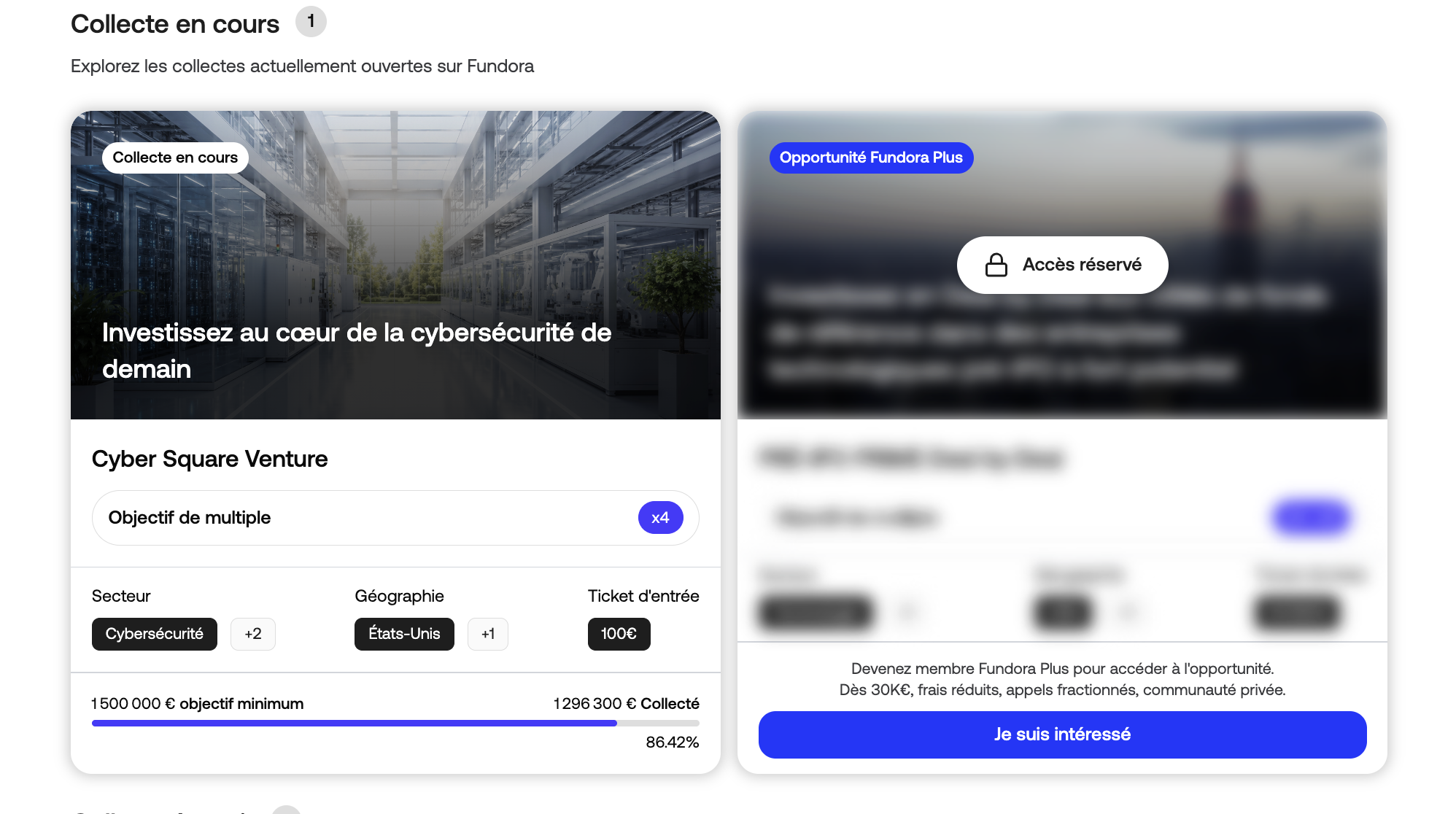
With Fundora, you can invest in AI beyond buying stocks already priced by the market. The platform provides access to private equity strategies typically reserved for institutional investors, financing unlisted tech companies and the computing infrastructure that powers artificial intelligence. You position yourself before the IPO, at the entry valuations negotiated during fundraising rounds. The goal is not to replace your stock market exposure, but to complement it with a sleeve that directly finances the players driving the current revolution.
Sources: France Invest / EY, "Net performance of French private equity as of end-2024", https://www.franceinvest.eu ; France Invest / Grant Thornton, "2025 Activity Study of French Private Equity" (March 2026), https://www.franceinvest.eu ; Euronext, https://www.euronext.com.
Pooled access via an FPCI associated with an SPV
Private equity funds traditionally require investment amounts beyond the reach of individual investors. Pooling changes this mechanism: subscriptions from multiple investors are aggregated into a Professional Private Equity Investment Fund (FPCI) associated with a dedicated vehicle, which then invests in the target funds. This significantly lowers the minimum subscription amount, which varies depending on the strategy currently open for investment.
Management by an AMF-authorized asset management company
Effective management is provided by Kyoseil Asset Management, an asset management company authorized by the Autorité des marchés financiers (AMF) under number GP-99040. Fundora identifies and proposes the strategies, while management is carried out within the scope of the mandate.
Diversified strategies rather than a single bet
Rather than concentrating your private equity allocation in a single fund, spread it across complementary approaches: venture capital for early-stage tech companies, growth equity for those with a proven business model, and more broadly, the strategies presented on our investing in private equity page. Targeted return multiples range between 2.5x and 4x, with no guarantee of results.
{{cta}}
Good to know
%201.avif)
THE WAY TO ACCESS PRIVATE FUNDS