

20,000 euros to invest: what strategy according to your profile

20,000 euros is a pivotal sum. Too much to sit idle in a savings account earning 1.5%, yet still too modest to buy a rental property alone in a major city. The real question, therefore, isn't just "what to invest 20,000 euros in," but how to allocate them to combine security, return, and diversification, depending on your time horizon and risk profile.
This guide reviews the investments accessible with this level of capital, their 2026 returns and real risks, then details three typical allocations. Finally, it shows how a portion of these 20,000 euros can be directed towards private equity, an asset class long reserved for high-net-worth individuals, now accessible to retail investors via Fundora.
Why make this capital work instead of letting it sit idle
Leaving 20,000 euros in a current account or a low-yield savings account has a real cost: inflation. Even back below 2%, inflation chips away each year at the purchasing power of uninvested savings. Over ten years, capital that doesn't work mechanically loses several thousand euros in real value.
Conversely, 20,000 euros well invested opens the door to true diversification. It's the amount from which you can spread your savings across several envelopes (life insurance, PEA, paper real estate) and several asset classes, without putting everything on a single vehicle. It is also sufficient capital to start gaining exposure to long-term investments that have historically been more profitable than guaranteed funds.
Three main objectives can guide this investment:
- Grow your capital over time through compound interest;
- Generate supplementary income via assets distributing rents, coupons or dividends;
- Diversify an existing portfolio to reduce dependence on a single market.
Steps to Take Before Investing
Before choosing an investment, three key considerations determine its success.
Build an emergency fund.
Before tying up any capital, keep 3 to 6 months of current expenses available in a savings account. This reserve prevents you from having to break a long-term investment at an inopportune time.
.avif)
.avif)
Define your time horizon.
An investment should be chosen based on when you'll need the money. Short term (less than 3 years): prioritize security and liquidity. Long term (8 years and more): accept some risk to aim for better returns.
Identify your risk profile.
Cautious, balanced, or dynamic: your tolerance for fluctuations determines the portion you can allocate to volatile assets (stocks, private equity) without undue stress.

With these foundations laid, you avoid the two most common mistakes: investing money you'll need too soon, and overestimating your risk tolerance to the point of panic selling at the first downturn.With these foundations laid, you avoid the two most common mistakes: investing money you'll need too soon, and overestimating your risk tolerance to the point of panic selling at the first downturn.With these foundations laid, you avoid the two most common mistakes: investing money you'll need too soon, and overestimating your risk tolerance to the point of selling in a panic at the first downturn.
The Best Investments for 20,000 Euros in 2026The Best Investments for 20,000 Euros in 2026The Best Investments for 20,000 Euros in 2026
With 20,000 euros, the range of investment options is wide. Here are the most relevant choices, from the most secure to the most dynamic.With 20,000 euros, the range of investment options is wide. Here are the most relevant choices, from the most secure to the most dynamic.With 20,000 euros, the range of investment options is broad. Here are the most relevant choices, from the most secure to the most dynamic.
Savings Accounts and Euro Funds: The Secure PortionSavings Accounts and Euro Funds: The Secure PortionSavings Accounts and Euro-Denominated Funds: The Secure Segment
Regulated savings accounts (Livret A and LDDS at 1.5%, LEP at 2.5% for eligible households) guarantee capital and liquidity, but only partially protect against inflation. They are perfect for emergency savings, not for growing capital over the long term. The euro fund within life insurance plays a similar role, with an average return of 2.6% in 2024 (estimated 2.65% for 2025 according to ACPR) and a capital guarantee.Regulated savings accounts (Livret A and LDDS at 1.5%, LEP at 2.5% for eligible households) guarantee capital and liquidity, but only partially protect against inflation. They are perfect for emergency savings, not for growing capital over the long term. The euro fund within life insurance plays a similar role, with an average return of 2.6% in 2024 (estimated 2.65% for 2025 according to ACPR) and a capital guarantee.Regulated savings accounts (Livret A and LDDS at 1.5%, LEP at 2.5% for eligible households) guarantee capital and liquidity, but only partially protect against inflation. They are perfect for emergency savings, not for growing capital over the long term. Life insurance euro-denominated funds play a similar role, with an average return of 2.6% in 2024 (estimated 2.65% for 2025 according to the ACPR) and capital guaranteed.
Life Insurance and PEA: Stock Market Investing with Tax AdvantagesLife Insurance and PEA: Stock Market Investing with Tax AdvantagesLife Insurance and PEA: Stock Market Investing with Tax Advantages
Life insurance remains the most flexible vehicle: euro funds for security, unit-linked funds (ETFs, stocks, real estate) for growth, and reduced taxation after 8 years (an allowance of 4,600 euros per year for a single person, 9,200 euros for a couple). The PEA (Equity Savings Plan) targets European stock markets with income tax exemption after 5 years (excluding social contributions of 17.2%). For exposure to global markets, index ETFs offer the best compromise between simplicity and cost: the MSCI World has shown an annualized performance of approximately 11% over 10 years, with fees often below 0.3%.Life insurance remains the most flexible vehicle: euro funds for security, unit-linked funds (ETFs, stocks, real estate) for growth, and reduced taxation after 8 years (an allowance of 4,600 euros per year for a single person, 9,200 euros for a couple). The PEA (Equity Savings Plan) targets European stock markets with income tax exemption after 5 years (excluding social contributions of 17.2%). For exposure to global markets, index ETFs offer the best compromise between simplicity and cost: the MSCI World has shown an annualized performance of approximately 11% over 10 years, with fees often below 0.3%.Life insurance remains the most flexible investment vehicle: euro-denominated funds for security, unit-linked funds (ETFs, stocks, real estate) for growth, and reduced taxation after 8 years (a tax allowance of 4,600 euros per year for a single person, 9,200 euros for a couple). The PEA, on the other hand, targets European stock markets with income tax exemption after 5 years (excluding social security contributions of 17.2%). For exposure to global markets, index ETFs offer the best balance of simplicity and cost: the MSCI World has an annualized performance of approximately 11% over 10 years, with fees often below 0.3%.
SCPIs and Indirect Real Estate: Property Without ManagementSCPIs and Indirect Real Estate: Property Without ManagementSCPIs and paper real estate: hands-off property investment
With 20,000 euros, buying a rental property directly has become difficult in major cities. SCPIs allow for fractional real estate investment without rental management. The average distribution yield was around 4.7% in 2025. However, be careful not to focus solely on this figure: after the share price correction, the average annual overall performance of SCPIs was only +1.46% in 2025, with an average share price decrease of -3.45%. SCPIs should be considered a long-term investment (10 years minimum).With 20,000 euros, buying a rental property directly has become difficult in major cities. SCPIs allow for fractional real estate investment without rental management. The average distribution yield was around 4.7% in 2025. However, be careful not to focus solely on this figure: after the share price correction, the average annual overall performance of SCPIs was only +1.46% in 2025, with an average share price decrease of -3.45%. SCPIs should be considered a long-term investment (10 years minimum).With 20,000 euros, buying a rental property directly has become difficult in major cities. SCPIs allow for fractional investment in real estate, without the need for rental management. The average distribution yield was around 4.7% in 2025. However, be careful not to look at this figure alone: after the correction in unit prices, the average annual overall performance of SCPIs was only +1.46% in 2025, with an average unit price decrease of -3.45%. SCPIs should be considered for the long term (10 years minimum).
Parking Spaces, Garages, and Targeted Real EstateParking Spaces, Garages, and Targeted Real EstateParking spaces, garages, and targeted real estate
With this budget, a parking space or garage can be acquired directly in some cities, offering a gross yield of 5 to 10%. It's an entry point into physical real estate, but it's illiquid and concentrated on a single asset.With this budget, a parking space or garage can be acquired directly in some cities, offering a gross yield of 5 to 10%. It's an entry point into physical real estate, but it's illiquid and concentrated on a single asset.With this budget, a parking space or garage can be acquired directly in certain cities, offering a gross yield of 5 to 10%. It's an entry ticket into physical real estate, but it's illiquid and concentrated on a single asset.
Real Estate Crowdfunding: High Returns, Real RiskReal Estate Crowdfunding: High Returns, Real RiskReal estate crowdfunding: high returns, real risk
Real estate crowdfunding advertises returns of 7 to 12%, but the risk is often understated. For the 2019 vintage, the delay rate reached 60.2% of amounts (source AMF), and about one in two projects is currently facing difficulties (Forvis Mazars / France FinTech 2025 barometer). The risk of developer default must be clearly factored in.Real estate crowdfunding advertises returns of 7 to 12%, but the risk is often understated. For the 2019 vintage, the delay rate reached 60.2% of amounts (source AMF), and about one in two projects is currently facing difficulties (Forvis Mazars / France FinTech 2025 barometer). The risk of developer default must be clearly factored in.Real estate crowdfunding boasts advertised returns of 7 to 12%, but the risk is often understated. For the 2019 vintage, the delay rate reached 60.2% of the amounts invested (source AMF), and about one in two projects currently faces difficulties (Forvis Mazars / France FinTech 2025 barometer). The risk of developer default must be clearly factored in.
Cryptocurrencies: Allocate with CautionCryptocurrencies: Allocate with CautionCryptocurrencies: to be approached with caution
Crypto assets can complement a dynamic allocation, but their volatility necessitates limiting exposure to a small portion of the portfolio (around 5% maximum), reserved for sophisticated investors.Crypto assets can complement a dynamic allocation, but their volatility necessitates limiting exposure to a small portion of the portfolio (around 5% maximum), reserved for sophisticated investors.Crypto assets can complement a dynamic allocation, but their volatility requires limiting exposure to a small portion of the portfolio (around 5% maximum), reserved for informed investors.
Private Equity: Diversification Long Reserved for High-Net-Worth IndividualsPrivate Equity: Diversification Long Reserved for High-Net-Worth IndividualsPrivate equity: diversification long reserved for high-net-worth individuals
Investing in unlisted companies (venture capital, growth equity, LBO, secondary, private debt) has long required investments of several hundred thousand euros. This asset class has shown a net IRR of 12.4% over 10 years in France (France Invest / EY). It is now accessible to individuals through pooled structures (see the Fundora section below).Investing in unlisted companies (venture capital, growth equity, LBO, secondary, private debt) has long required investments of several hundred thousand euros. This asset class has shown a net IRR of 12.4% over 10 years in France (France Invest / EY). It is now accessible to individuals through pooled structures (see the Fundora section below).Investing in unlisted companies (venture capital, growth equity, LBOs, secondary markets, private debt) long required tickets of several hundred thousand euros. This asset class shows a net IRR of 12.4% over 10 years in France (France Invest / EY). It is now accessible to individuals through pooled structures (see Fundora section below).
How to allocate €20,000 according to your profileHow to allocate €20,000 according to your profileHow to allocate 20,000 euros according to your profile
There is no universal allocation: the right distribution depends on your investment horizon and risk tolerance. Here are three examples of structures, from the most conservative to the most aggressive.There is no universal allocation: the right distribution depends on your investment horizon and risk tolerance. Here are three examples of structures, from the most conservative to the most aggressive.There is no universal allocation: the right distribution depends on your investment horizon and risk tolerance. Here are three examples of structures, from the most conservative to the most aggressive.
Conservative ProfileConservative ProfileConservative profile
Capital preservation is the priority. The majority remains in guaranteed or low-volatility investments (guaranteed funds, savings accounts, real estate funds), with a small allocation to equities and limited exposure to private equity (around 5 to 10%, or €1,000 to €2,000) to seek long-term returns without distorting the risk profile.Capital preservation is the priority. The majority remains in guaranteed or low-volatility investments (guaranteed funds, savings accounts, real estate funds), with a small allocation to equities and limited exposure to private equity (around 5 to 10%, or €1,000 to €2,000) to seek long-term returns without distorting the risk profile.The priority is capital preservation. The bulk remains in guaranteed or low-volatility assets (euro funds, savings accounts, SCPIs), with a small allocation to stocks and limited exposure to private equity (around 5 to 10%, or 1,000 to 2,000 euros) to seek long-term returns without distorting the risk profile.
Balanced ProfileBalanced ProfileBalanced Profile
The goal is to combine growth and stability. The allocation to equities and real estate funds increases, and private equity can represent up to 10% of the portfolio (approximately €2,000), a proportion commonly recommended to diversify assets without overexposure.The goal is to combine growth and stability. The allocation to equities and real estate funds increases, and private equity can represent up to 10% of the portfolio (approximately €2,000), a proportion commonly recommended to diversify assets without overexposure.The objective is to combine growth and stability. The share of equities and SCPIs increases, and private equity can represent up to 10% of the portfolio (approximately €2,000), a proportion commonly recommended for diversifying assets without overexposure.
Dynamic ProfileDynamic ProfileDynamic Profile
With a long-term horizon and a good tolerance for fluctuations, growth assets take precedence. Private equity can account for 15 to 20% of the allocation (€3,000 to €4,000), alongside equity ETFs, to aim for the highest performance over 8 to 10 years.With a long-term horizon and a good tolerance for fluctuations, growth assets take precedence. Private equity can account for 15 to 20% of the allocation (€3,000 to €4,000), alongside equity ETFs, to aim for the highest performance over 8 to 10 years.With a long-term horizon and a good tolerance for fluctuations, growth assets dominate. Private equity can account for 15 to 20% of the allocation (€3,000 to €4,000), alongside equity ETFs, to aim for the highest performance over 8 to 10 years.
Good to know
Private equity, the asset class that changes the game
Among all investments accessible with 20,000 euros, private equity is the one that has long made the difference in large portfolios, without being available to individual investors. Investing in unlisted companies allows you to capture value creation where it happens today: before the IPO, when companies are experiencing their strongest growth.
Why private equity outperforms over the long term
Over 10 years, French private equity shows a net IRR of 12.4% (France Invest / EY), outperforming most traditional investments. This performance premium is explained by illiquidity and active company support by funds. One nuance worth noting: performance dispersion is significant. Only first-quartile funds clearly outperform listed markets. Fund selection is therefore critical.
Access long reserved for institutions
The historical barrier was the minimum ticket: private equity funds often require €200,000 to €1 million in minimum subscription. This is precisely the barrier that pooled vehicles lower today, by grouping subscriptions from several individual investors within the same structure.
How much can 20,000 euros earn
The final return depends on the chosen vehicle and above all the duration: thanks to compound interest, gains reinvest and accelerate over time.
As a rough guide, 20,000 euros invested at 5% generates approximately €1,000 in income in the first year, roughly €83 per month. This is still far from allowing you to "live off your investments", but it is a supplementary income that grows with capital and time.
Mistakes to avoid when investing 20,000 euros
- Investing everything at once at the peak. Spreading contributions smooths the entry price and reduces the risk of bad timing.
- Neglecting emergency savings. Investing without a safety reserve often forces you to sell at the worst time.
- Chasing the advertised return. A 10% rate in real estate crowdfunding hides a real default risk.
- Underestimating fees. Over the long term, 1 to 2% in annual fees significantly erodes performance. Favor low-cost vehicles (ETFs, transparent structures).
- Forgetting diversification. Concentrating 20,000 euros on a single asset exposes you to a sudden loss.
- Confusing liquidity with return. The most profitable investments are also the least liquid: they are meant for a long time horizon.
Invest a portion of your capital in private equity with Fundora
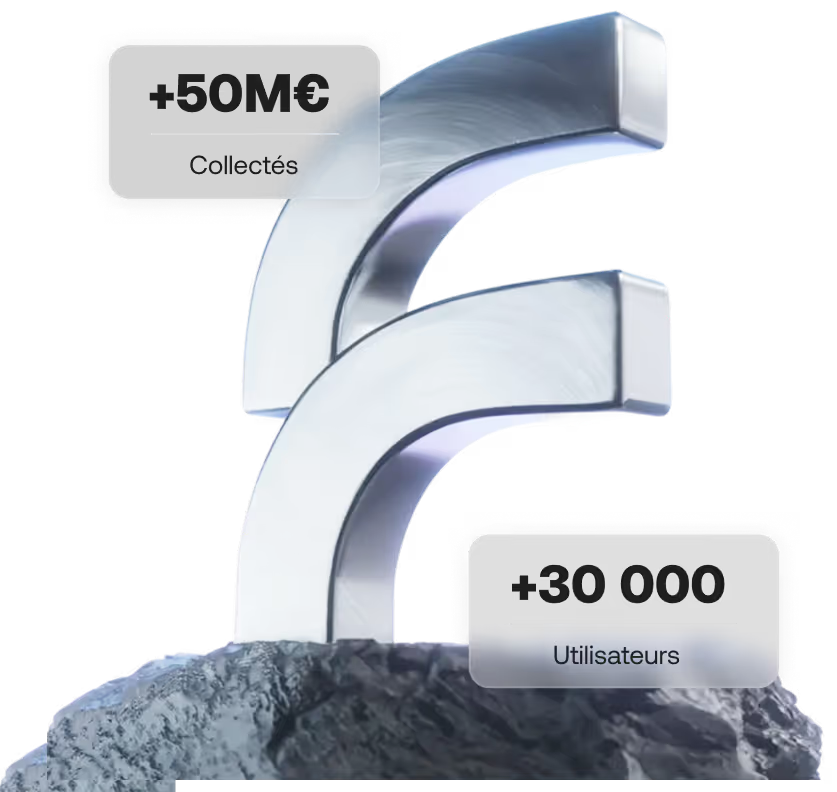
Fundora makes private equity accessible to individual investors, where institutional funds require minimum tickets of several hundred thousand euros. On a 20,000 euro allocation, dedicating 10 to 20% to unlisted assets (i.e. €2,000 to €4,000) allows you to diversify your portfolio toward the historically best-performing long-term asset class, without distorting the overall balance of your portfolio.
THE WAY TO ACCESS PRIVATE FUNDS
How Fundora lowers the barrier to entryHow Fundora lowers the barrier to entry
Fundora relies on pooled structures: an FPCI (Professional Private Equity Fund) and SPVs (Special Purpose Vehicles) that group subscriptions from several individual investors within a single structure. This structure then invests directly in target funds, which lowers the entry ticket typically reserved for institutional investors. This democratizes access to private equity, with a pooled institutional entry ticket.Fundora relies on pooled structures: an FPCI (Professional Private Equity Fund) and SPVs (Special Purpose Vehicles) that group subscriptions from several individual investors within the same structure. This structure then invests directly in the target funds, which lowers the entry ticket typically reserved for institutional investors. Access to private equity is thus democratized, with a pooled institutional ticket.
Rigorous selection, regulated managementRigorous selection, supervised managementRigorous selection, supervised management
FFundora identifies and offers strategies selected for their institutional quality (venture capital, growth equity, LBO, secondaries, private debt), with target multiples ranging from 2.5x to 4x. Effective management is provided by Kyoseil Asset Management, a portfolio management company approved by the AMF (license number GP-99040), under the mandate. This regulatory oversight ensures reliability in a field where fund selection makes all the difference. Depending on your objective, secondary private equity strategies offer more advanced maturity and a shorter lock-up period, while private debt funds aim for more regular income. strategies offer more advanced maturity and a reduced lock-up period, while aim for more regular income.Fundora identifies and offers strategies selected for their institutional quality (venture capital, growth equity, LBO, secondaries, private debt), with target multiples ranging from 2.5x to 4x. Effective management is provided by Kyoseil Asset Management, a portfolio management company approved by the AMF (license number GP-99040), under the mandate. This regulatory oversight ensures reliability in a field where fund selection makes all the difference. Depending on your objective, strategies offer more advanced maturity and a shorter lock-up period, while aim for more regular income.Fundora identifies and offers strategies selected for their institutional quality (venture capital, growth equity, LBO, secondary, private debt), with multiple objectives ranging from 2.5x to 4x. Effective management is provided by Kyoseil Asset Management, a portfolio management company approved by the AMF (license number GP-99040), under the mandate. This regulatory framework guarantees reliability in a field where fund selection makes all the difference. Depending on your objective, strategies offer more advanced maturity and a shorter lock-up period, while aim for more regular income.
Good to know
{{cta}}
%201.avif)